
If you’re anything like me you’ve been umming and ahing over a range of coins for some time now. Kicking yourself when the one you didn’t invest in pumps, and, inevitably, when the one you did crashes.
You’ve been doing your research. Scanning white papers, trawling telegraph feeds, reading through the rabble of comments on Reddit. You’re trying to pinpoint the technology with the best real world applications, a coin that will deliver the best ROI, and a team that you can trust.
You’re likely extremely confused and conflicted. Still weighing up your options and scouring the exchanges for an early buy signal. It’s stressful, stifling and, at the end of the day, boring.
But don’t worry, I’ve got a little advice for you. You can take it or leave it. Do what you want with it. But, and as much as I would love to, I can’t take any responsibility for what you do do with it. That’s on you.
Ready?
Invest in Ambrosus.
I mean, you probably already got that that was the advice from the title up there, but the build up was still pretty decent, wasn’t it?
Why Ambrosus?
Thanks for asking.
For those who don’t know, Ambrosus is a Swiss blockchain startup whose technology uses smart contracts to track the supply chain of foods and medicines, ratifying the integrity of the product to the user at every stage of the supply chain.
The future-view is to enable autonomous supply chains, and to improve the efficiency and transparency of distribution processes.
Sounds like a nice idea, doesn’t it? But let’s break that down a bit to see why I think Ambrosus is more than just a cute concept.
The technology
I’ll try to be brief here whilst attempting to get all the technical details correct, so bear with me for a minute.
Ambrosus is an end-to-end system including both hardware and software.
The software layer of the Ambrosus protocol creates smart contracts and is built on the Ethereum blockchain and the InterPlanetary File System (IPFS). These contracts are used to store important information such as temperature, origin and content on products at all stages of the supply chain.
Buyers and sellers can execute terms of agreement by comparing the Measurements Smart Contract to the Requirements Smart Contract, autonomously verifying that the products meet expected standards. Payments can then be automatically settled on the blockchain if contract requirements are met.
This information is immutable and able to be authenticated and viewable by any one at any time, meaning that buyers, from primary sourcing to end-sale, can be sure of the quality, origin and ethicality of their products.
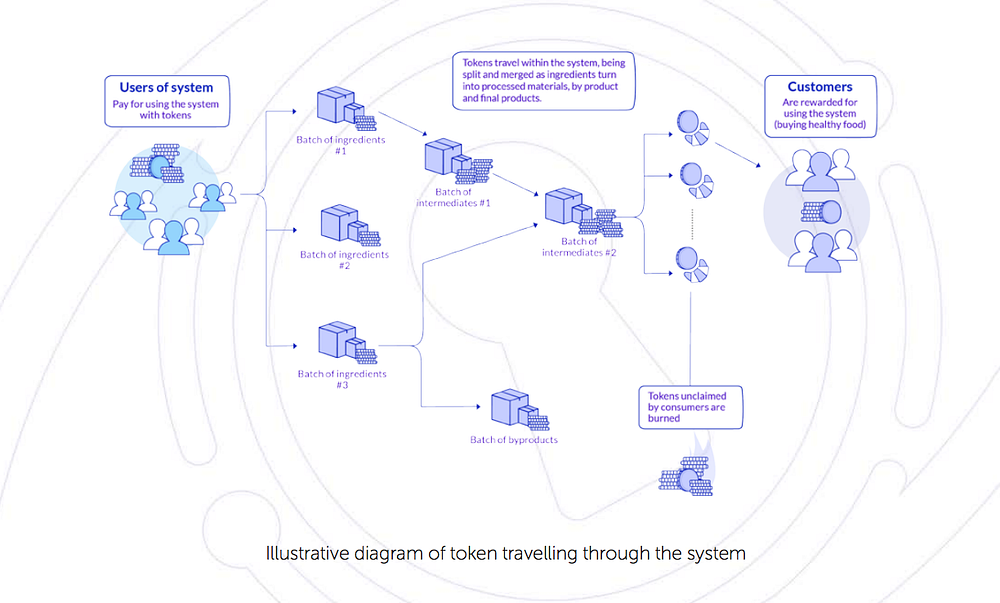
Ambrosus’ token Amber ($AMB) is used to attach supply chain data to the blockchain itself. These tokens are bonded to the product until a ‘termination event’, at which point the product is either bought, delivered or discarded. The token can then be claimed by the end-consumer and used to purchase more Ambrosus-tracked products, encouraging adoption and providing promotion for adoptive brands.
On the hardware side
Companies using the Ambrosus protocol will attach tags, tracers and sensors to their products.
- The tag will contain information on the product’s identity.
- The tracer will contain information on the origin of the product and where it’s been processed.
- Tamper-proof sensors monitor the status of the product using optical, electrical, acoustical and nuclear techniques.
Straddling the concept of the Internet of Things, products are designed to be verifiable from your phone, meaning that you can get a product delivered, scan the code and immediately access all data on its transport route, the temperature of the product during transport, its chemical composition… The list goes on.
Whilst there are those who argue there has been no use for blockchain technology (you know who that’s linking to), strangely they don’t mention supply chains in their polemic, which, for me, appear to be the most obvious route for real-world application.
Why is this important?
Brand trust.
A recent study from PricewaterhouseCoopers found that brand trust was the most important factor for a consumer’s purchase decision, just behind ‘they usually stock my item’.

Amongst respondents in China (whose robust economy presents a gargantuan market opportunity), 21% of those surveyed cited brand trust as their number one reason for making a purchase decision. In the US this figure was 16%.
So how do you develop brand trust?
…brand trust implies much more than understanding shopping behaviour, of course. Trust can be earned through transparency regarding sources/suppliers and ingredients, dependability and consistent quality products and services, genuine engagement in community and charity activities, admitting errors and making up for them — the list goes on and on. These trust factors hold not just for established brands but can also be used as guiding principles for newly launching brands.¹
Consider, then, Ambrosus’ mission statement:
To create useful solutions for supply chains that enhance their quality, integrity and transparency, thus improving the quality and integrity of the products we all consume.
The main tenets of the technology are the underlying principles of brand trust, which is the most important factor for consumer purchases (next to having the item in the first place), which is itself the most important contributor to brand loyalty…
Post-purchase behaviour
The most important and, shamefully, most overlooked aspect of brand marketing is developing brand loyalty and repeat purchases. Which is criminal when you consider:
- Increasing customer retention rates by 5% increases profits by 25% to 95%
- Acquiring a new customer is anywhere from five to 25 times more expensive than retaining existing ones.²
Unfortunately, with the opportunities presented by comparison websites, saturation and sheer access to products from around the globe at the click of a button, loyalty is now more elusive than ever.
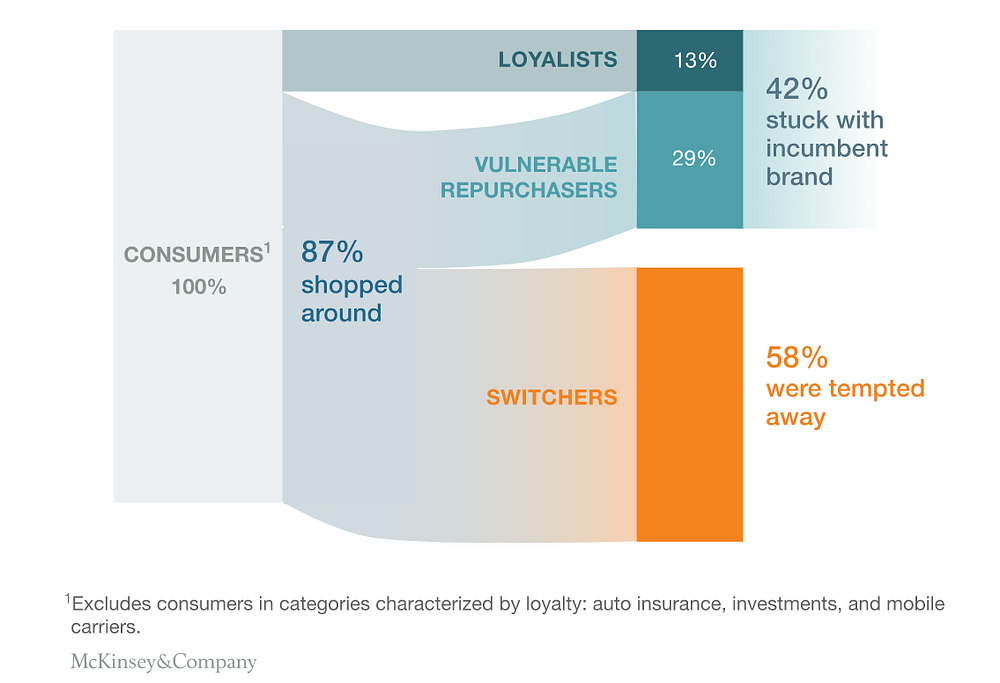
Of course, it will be down to the individual brand to provide a post-purchase experience that encourages re-buying and loyalty, but Ambrosus’ coin ecosystem, through incentivising consumers to repurchase by rewarding them with $AMB, develops a native loyalty program to increase retention.
Ethical purchasing
Ethical purchasing practices have been steadily increasing in the UK over the last 14 years.
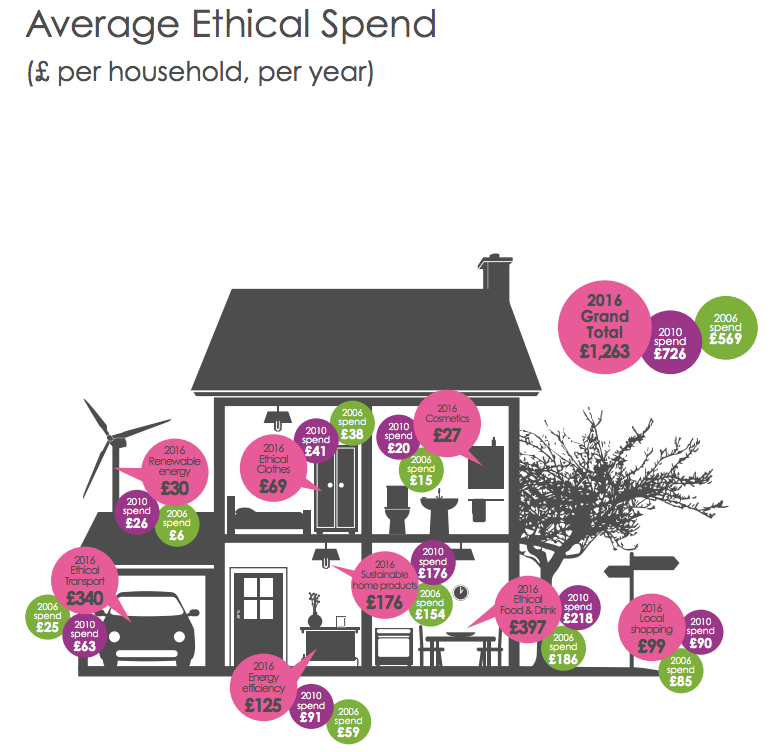
In 2017 alone the value of ethical spending grew by 3.2% to £81.3 billion, whilst ethically sourced food and drink saw a 9.7% rate of growth. At the same time there was a 30% increase in vegetarianism and a 150% increase in veganism.
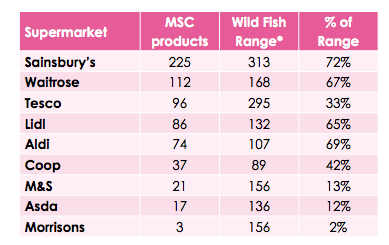
The Marine Stewardship Council’s (MSC) operations now extend to 12% of the world’s wild marine catch. There was a 16.1% growth in sales of Rainforest Alliance labelled products (a £330 million increase in revenue). Consumers buying free-range eggs is up 32%, the organic food and drink market grew to £1.81 billion — a year-on-year increase of 3.8%. The food service industry spent 19.1% more on organic products in 2016…
What does all this have to do with Ambrosus?
This increase in not only consumer behaviour, but NGO and sector growth demonstrates that the demand for ethically sourced, traceable products is on the rise and shows no signs of shying.
The Ambrosus protocol therefore presents a solution not only for the end-consumer like you and me, who are conscious of the products that they consume, but also for NGOs such as the MSC to monitor the sourcing, production and sale of sustainable products.
Partnerships
It’s no surprise then that much-maligned manufacturer Nestlé have been in preliminary talks with Ambrosus regarding pilot projects in what could be an attempt to rectify their reputation, and with Fabiola Dionisi, Global R&D Program Leader of Healthy Lipids at Nestle S.A., a scientific advisor on the Ambrosus project, it seems this might have some legs.
At the same time rumours are abound concerning confirmed partnerships with 3 large companies currently under the covenant of NDAs. As with all rumours, online detectives claim to have deciphered who these companies are: GlaxoSmithKline, Deloitte and German software company SAP.
I don’t claim to be able to testify to the veracity of those rumours — I can’t — but given Ambrosus’ focus, and the (minuscule amount of) information that has been leaked, I don’t think it’s a stretch to think that these are the companies that they would be in talks with.
The team
I’m not about to extoll the virtues of every member of the Ambrosus team, you can decide whether you like them for yourself here.
Who I will talk about, however, is their latest acquisition, Stephen Croncota.

Up until just recently Stephen Croncota was the Chief Marketing Officer for Versace, a position he also previously held between 2003–2006.
As well as a stint at E!, Mr. Croncota also served as the Senior Vice President of Warner Bros. where he oversaw the creation of Cartoon Network as Creative Director. An impressive résumé.
In the press release concerning Croncota’s appointment, Ambrosus wrote:
At Ambrosus Croncota will oversee branding, advertising, social media, digital marketing, public relations, events and creative services.
An appointment of this stature is a clear signal that the company’s marketing is about to step it up a notch. And if I were a lesser man and paid too much attention to rumours, I might suggest that this move must be tied to game-changing announcements planned for the near future.
But that’s not me. It might be you. It’s not me.
The market cap
Ok, you’re not just in it because you like the technology or the team. The reason you’re thinking about buying $AMB is because you are wondering whether it might sky-rocket in the future and make you a tidy sum of money.
Don’t worry, it’s ok. That’s what we’re all thinking.
So can you?
We’re not entirely sure yet. We have to wait until May 4th when Ambrosus’ tokenomics are set to be outlined (I’ll update this post then). This will be the brainchild of Prof. Roger Wattenhofer, head of Distributed Computing at ETH Zurich, who has been working on the system since his appointment in January this year.
Until then, what we can do is make a crude comparison with similar coins.
The current circulating supply of $VEN is around 500M, with $WAN and $AMB circulating around 100M each.
At the time of writing $VEN is trading for $4.48, $WAN for $8.39.
$AMB is trading for only $0.74.
Taking the aforementioned currencies as ‘industry benchmarks’, it seems that $AMB may be dramatically underpriced. That said, market value is an indication of investors’ perceptions of the business’ prospects. And the current price must be taken as a fair reflection of present interest in the coin — but with big announcements in the pipeline, the appointment of a new CMO, a burgeoning market… I personally expect interest to increase sharply, and the price of the coin with it.
Finally, for long-term hodling, with a total supply of ~360M, as (and if and when) demand for $AMB increases, your individual coins are likely to increase in value due to scarcity.
Ambrosus vs VeChainThor Vs WaltonChain Vs…
Ok, ok. There are plenty of supply chain solutions based on blockchain technology out there. So why is Ambrosus the one that I think is worth investing in?
Well, I don’t.
I think all of these technologies have their merits. Effectively all of these companies are looking to tag items on the blockchain in order to monitor and report on them. And I think they’ll all do well. And if you’re keeping a smart portfolio you would have a proportion of all of these coins in it.
To reiterate: I think supply chain is one of the most obvious, real-world application of blockchain technology (aside from cryptocurrency) and will see rapid adoption once breakthrough happens.
Competitiveness has always been a driver for innovation in the free-market, and, as far as I can see it, healthy competition between these blockchain startups will do nothing but foster innovation and creativity. The idea that there ought to be ‘one ring to rule them all’ is fallacious and unhelpful.
So, no. I am not telling you that Ambrosus is the one company that understands how blockchain works. Nor am I saying that their application of these systems makes more sense, or will definitely be more profitable than any other.
So why am I writing this article on Ambrosus and not the others?
Good question.
Let me break it down simply:
- The company’s mission statement focuses on the core of what a modern business needs to do in order to improve brand trust.
- Improved brand trust will lead to greater loyalty, bolstered by their native loyalty program, which in turn incentivises businesses to sign up.
- Focusing on food and medicines, about which modern consumers are highly conscious, gives the company a large niche upon which they can capitalise.
- The ethical sectors of the food & drink industry, which have seen constant and considerable growth in recent times, are the obvious fit. Positioned right, this could place Ambrosus at the forefront of the burgeoning market of conscious consumers.
- The company itself is making big movements both in terms of internal acquisition and external partnerships.
- The price point is right, right now.
So there you have it. Thoughts?
Full disclosure: I am not associated with the Ambrosus project, and am, currently, lightly invested in $AMB. I am, however, planning to go (almost) all in.
¹ https://www.pwc.com/gx/en/retail-consumer/assets/consumer-trust-global-consumer-insights-survey.pdf
² https://www.marketingtechnews.net/news/2018/mar/20/live-chat-bots-and-chat-bots-edge-out-email/